
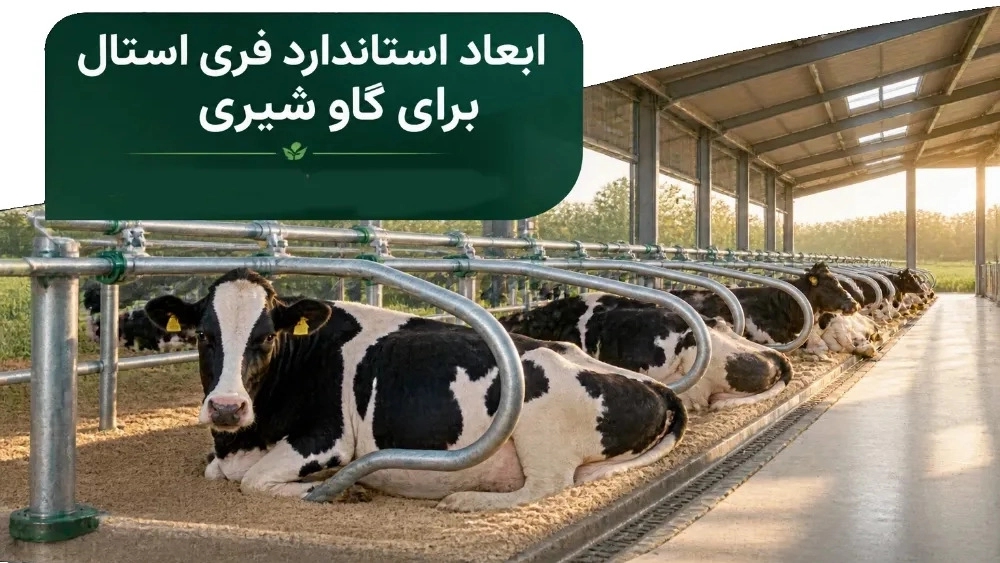
Designing a suitable place for dairy cows is one of the most important factors in increasing milk production, reducing diseases and improving herd management. In modern livestock farms, the use of the free stall system has become very important because it provides freedom of movement for cows, better management of the herd and the possibility of easy cleaning. However, the successful operation of this system is not limited to the construction of the hall and the installation of equipment; Rather, the strict adherence to the free stall standard dimensions for dairy cows plays a decisive role in livestock farming performance.
If the size of the free stall is too small, the cow will have difficulty getting up, lying down or moving. On the other hand, if the space of the free stall is designed too large, the probability of the animal body being in an inappropriate position, contamination of the bed and increase of construction cost will increase. Therefore, the dimensions of the free stall should be determined based on the weight, size, breed and age group of the cows.
Damiar Taha Sanat Parse company, by providing specialized solutions in the field of designing, equipping and implementing dairy cow stalls, helps livestock farmers to create standard, durable free stalls that suit the needs of their herd. In this article, the most important dimensions of the free stall standard for dairy cows and the practical points of its design are reviewed.
What is Freestal?
Free stall is a dedicated and semi-enclosed space that cows use to rest, sleep and ruminate. Unlike traditional systems where cattle are locked in a certain place, in the free stall system, the cow is free to move between the resting place, manger, watering hole and movement paths.
Each freestall usually consists of parts such as a bed, side dividers, breast restraint tube, neck bar and sometimes a board or end edge. These components must be installed in such a way that the cow can easily enter the free stall, lie down in it, rest and get up without injury.
The main goal of free stall design is to increase the cow's rest period and reduce the pressure on the hoof, joints and movement organs. A cow that has a proper rest area will devote more time to sleeping and ruminating and will usually produce better milk.
Why is it important to comply with the standard dimensions of Freestal?
Dimensions of standard freestall for dairy cows is not only a matter of construction; Rather, it is directly related to the health, well-being and productivity of livestock. Dairy cows, especially high-yielding cows, spend a significant part of the day and night resting. If the free stall is not suitable, the animal may refuse to sleep in it or be in the wrong position.
The most important advantages of observing the proper dimensions of the free stall are:
- Reduction of joint injuries and skin wounds
- Reduction of lameness and diseases related to the hoof
- Increase of rest and rumination time
- Reduction of contamination of the cow's body and udder
- Reduction of the possibility of mastitis
- Increase of feed consumption and milk production
- Improvement of animal movement and access to water and feed
- Increase of economic life Cattle
- reducing the costs of treatment and removal of cattle
- improving the daily management of the place
If the space of the free stall is designed properly, the cow will put its body in the right direction when sleeping, and feces and urine will enter the bedding area less. This helps to maintain the hygiene of the free stall and reduce the need for continuous cleaning.
Standard free stall dimensions for dairy cows
Freestall dimensions are determined by cow size, but for mature dairy cows of common breeds such as Holsteins, freestall length is usually between 240 and 270cm and width between 115 and 125cm. Choosing the exact size should be done according to the weight, hip height, body length and physical condition of the herd.
For large and productive cows, longer freestall length is important. In this group of animals, the length of free stall can be considered about 260 to 280 cm. The appropriate width is usually around 120 to 125 cm. For smaller cows or lighter breeds, a length of 230 to 250 cm and a width of 110 to 120 cm can be suitable.
In free stall design, you should not only pay attention to fixed numbers. The most important principle is that the cow should be able to move its head and neck naturally when standing up. To get up, the cow first moves its head forward and slightly to the side; Therefore, the space in front of the free stall should not be blocked by a wall or inappropriate equipment.
Suitable length of free stall
The length of the free stall is one of the most important indicators of dairy cow stall design. The standard length should be such that the front part of the cow's body has enough space for movement and the rear part of the free stall also allows for the correct positioning of the movement organs.
For mature dairy cows, a total free stall length of between 240 and 270 cm is usually recommended. In free stalls with free head space, the length can be adjusted according to the structure of the stand. If the free stall is limited to a wall or closed barrier, more space should be provided for the movement of the cow's head and neck when taking off.
The short length makes the cow have to sit diagonally or semi-sitting in the free stall. This state causes more contamination of the body, pressure on the joints and reduction of rest time. On the other hand, too much length may cause the animal to move forward too much and wastes accumulate in the bed.
One of the practical methods to determine the free stall length is to check the size of large herd cows. The design should be based on the largest group of livestock, but if there are different groups, it is better to set up separate stalls for dry cows, heifers, newborn cows and high-yielding cows.
Suitable width of free stall
The width of the free stall should be enough for the cow to lie down comfortably and put its limbs in a natural position. Less than the standard width causes the cow's body to come into contact with the separators and increases the possibility of causing wounds in the hip, thigh, and shoulder.
For mature dairy cows, the standard freestall width is usually between 115 and 125 cm. In herds with very large cows, a width of 120 to 130 cm can also be suitable. For smaller heifers and cows, the width of the free stall should be reduced so that the animal is in the center of the litter and there is less contamination.
If the width of the free stall is too small, the cow will not be able to turn easily or place its feet in a natural position. Excessive width may also cause the cow to sleep transversely in the stall and contaminate more of the litter. Therefore, the correct installation of freestal separators is very important.
Neck bar height in free stall
The neck bar is one of the important components of the free stall that adjusts the cow's standing position and prevents the animal from moving too far forward. The height of the neck bar should be determined according to the height of the cow's stall and the size of the animal's body.
For mature dairy cows, the height of the neck bar from the surface of the litter is usually considered to be about 115 to 125 cm. The horizontal distance of the neck bar from the rear edge of the free stall is also usually set at about 165 to 180 cm. These measurements should be checked when the cow is standing, not just based on the construction plan.
If the neck bar is installed too low, the cow will feel restricted when entering or leaving the free stall and may refuse to use it. Installing it too high also makes the animal move forward too much and contaminate the bed.
The neck bar should have a smooth surface, without sharp edges and resistant to moisture and impact. The design of its connections should also be such that it does not break or change its shape due to the continuous impact of livestock.
Height of freestal separators
Separators are installed to define the boundaries of each free stall and prevent cattle from entering the adjacent space. These separators should not restrict the natural movement of the animal. Their height and shape should be such that the cow does not touch them when sleeping and getting up.
The front part of the separator is usually connected to the main structure and the back part continues until near the edge of the free stall. The proper distance between the separators should be compatible with the width of the free stall. In many standard positions, the use of galvanized or coated metal separators is recommended.
Improper separators can cause sores on the shoulder, hip or legs of the animal. Also, if these parts are installed too thick or close to the bed surface, the cow will have problems when turning its body and getting up. Damyar Taha Sanat Parse can provide advice on choosing the type, size and installation method of suitable separators for different herds.
Slope and height of freestal bed
The free stall bed should be soft, dry and have a suitable slope. A very high slope causes the cow to slide and puts pressure on the movement organs. A very low slope also makes it difficult to drain moisture and liquids.
Usually, the slope of the freestal bed is considered to be about 2 to 4%. This slope should be created slowly from the front to the back. The surface of the substrate should not have breaks, dents or sharp points.
The height of the bed relative to the passage is also important. If the bed is too low, it becomes difficult for the cow to enter and the possibility of contaminated water and excrement entering the resting place increases. If the bed is too high, the possibility of livestock slipping when entering and exiting will increase.
In modern free stalls, special animal mats, washed sand, standard tires or a combination of bedding materials can be used. The choice of bed should be done according to weather conditions, cleaning system, maintenance cost and type of herd.
The dimensions of the passage next to the free stall
Freestall design is not complete without consideration of crossing paths. The cow should be able to easily leave the free stall and access the drinking trough, manger or milking area. A narrow crossing path causes livestock density, increases collisions and reduces the comfort of the herd.
The width of the passage behind the free stall is usually considered between 280 and 320 cm. In halls where the number of livestock is large or cows cross the track at the same time, a wider width can have better performance.
The track floor should be non-slip, resistant and washable. The presence of suitable grooves in the concrete floor prevents livestock from sliding. The grooves should not be too deep or sharp, as they may cause damage to the cow's hoof.
The path between two rows of free stalls should have enough space for cows to pass at the same time. In the basic design, the watering place, the manger, the gates and the milking path should also be placed in such a way that the cattle move without stopping and crowding.
Free stall dimensions for heifers and smaller cows
One of the common mistakes in livestock farms is to use the same free stall size for all age groups. Heifers and young cows are smaller than mature cows and cannot have a proper body position in large free stalls.
For young heifers, the length of the free stall is usually considered to be about 190 to 220 cm and the width is about 90 to 105 cm. For larger heifers, a length of 220 to 240 cm and a width of 100 to 115 cm can be suitable.
Exact dimensions should be determined based on the age, weight and body size of the animal. Using a large free stall for heifers causes the animal to sleep in inappropriate parts of the bed, to place its body diagonally, and to cause more pollution.
Division of the stall based on weight groups, in addition to increasing animal welfare, simplifies cleaning and provides the possibility of dedicated feeding and care.
Relationship between free stall dimensions and milk production
Dairy cows need enough rest to produce milk. During sleep, the blood flow in the breast increases and the body will have more opportunity to rebuild the muscles and organs. For this reason, standard freestal can indirectly affect milk production.
When the cow spends less time resting due to lack of space or improper design, it spends more time standing. This position increases the pressure on the hoofs and joints and increases the likelihood of lameness. Lame cows usually go to the manger and watering hole less often, and reducing feed consumption can reduce milk production.
On the other hand, clean and suitable freestal helps reduce breast contamination. Reducing the humidity and pollution of the bed can reduce the possibility of mastitis and reduce the medical costs of animal husbandry.
The role of Damiyar Taha Sanat Parse in Freestall design
Damiar Taha Sanat Parse, focusing on the needs of the animal husbandry industry, can help livestock farmers in the field of designing and equipping free stalls, choosing the right parts, and implementing the principles of stalls. Each ranch has its own conditions and the same version cannot be used for all salons.
The number of livestock, breed of cattle, dimensions of the hall, weather conditions, manure management method, type of bed and investment budget are among the factors that should be checked before the implementation of free stall. A professional design can prevent additional costs in the future and increase the useful life of the equipment.
Choosing durable and washable parts, using metals with appropriate coating, installing separators accurately and observing safety principles are services and solutions that are important in equipping modern stands. Cooperating with a group of experts like Damyar Taha Sanat Parse helps the farmer to have a place that fits the real conditions of his herd.
How to choose the best dimensions of free stall?
In order to choose the best dimensions of the free stall, accurate measurements of the herd cows must be done first. Measurement of hip height, body length, shoulder width and livestock weight can provide appropriate information for design. It is better to design based on the largest livestock group and consider a separate space for heifers and smaller cows.
In the next step, the type of bed, cleaning method, ventilation system and movement paths should be determined. The free stall must be in harmony with other parts of the stand. Even if the dimensions of the free stall are standard, but the passageway is narrow or the hall floor is slippery, the overall performance of the stall will not be optimal.
Also, it is necessary to check indicators such as the amount of cattle using free stalls, the number of lame cows, the state of cleanliness of the body, the presence of skin wounds, and resting time. This information helps the rancher to identify and correct possible problems early.
summary
Standard free stall dimensions for dairy cows depend on factors such as breed, weight, age, body size and management conditions. For mature dairy cows, a length of about 240 to 270 cm and a width of about 115 to 125 cm are usually suitable, but these sizes should be modified according to the actual conditions of the herd.
The height of the neck bar, the position of the separators, the slope of the bed, the quality of the floor, the width of the passage and the type of materials also have a great effect on the performance of the free stall. The purpose of the standard design is to provide a natural opportunity to sleep and get up, increase rest time, reduce lameness, maintain breast health and improve milk production.
To achieve a safe, hygienic and economic position, it is better to design and implement the free stall with the advice of experts. Damyar Taha Sanat Parse, by providing specialized equipment and solutions in the field of dairy cattle housing, can be a suitable companion for livestock farmers in the construction and equipping of modern livestock farming.
For mature dairy cows, the freestall length is usually 240-270 cm and the width is about 115-125 cm.
The appropriate width for an adult Holstein cow is usually 120-125 cm, but the actual weight and size of the herd should also be checked.
The height of the neck bar from the surface of the bed is usually about 115 to 125 cm and should be adjusted according to the height of the cow stall.